

Unbatch: Advanced
The Unbatch node’s Advanced tab does the inverse of batch aggregation: it pushes a value carried on the batch back down onto the members coming out of it.
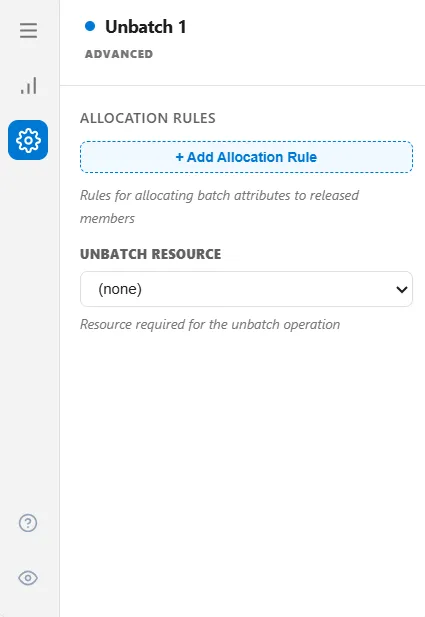
Allocation Rules
Section titled “Allocation Rules”Each rule names a Source Attribute on the batch, a Method, and a Target Attribute to write on each member.
| Method | Each member receives |
|---|---|
| Proportional | An equal share of the value |
| Equal | An equal share of the value |
| Copy | The whole value, unchanged |
| By Weight | A share in proportion to a per-member weight |
Proportional and Equal do the same thing. Both divide the batch value by the number of members being released and give each an equal share. There is no difference between them, so pick either.
Copy does not divide anything: every member gets the full value. Use it for something that describes the batch rather than something the batch holds, such as a lot number or a received date, and expect the total across members to be larger than the batch figure.
By Weight reveals a Weight Attribute, read from each member. A member’s share is its weight over the total weight of the release. Two things to watch:
- A By Weight rule with no Weight Attribute is skipped entirely. Not divided equally, not copied: no allocation happens at all, and nothing warns you. The field is not marked as required, so it is easy to leave empty.
- If every member’s weight is zero, the rule falls back to equal shares.
Unbatch Resource
Section titled “Unbatch Resource”Name a resource to seize for the unbatch operation, so the labour or equipment of unpacking appears in resource utilization and cost.
It is only seized when the unbatch actually takes time. With the default unbatch time of 0 on the General tab, the operation completes instantly and the resource is never seized, never charged, and never shows any utilization. Nothing couples the two fields, so if you name a resource here, give the node an unbatch time as well.
As with the batch node’s formation resource, the claim is best-effort. If the resource is busy the unbatch goes ahead regardless, so this accounts for the effort rather than constraining the rate.