

Materials and the Definitions panel
Everything in a fluid model is measured in the unit of the material it handles, so the material comes first. A tank has no meaningful capacity, and a pipe no meaningful rate, until the product knows whether you mean gallons, liters or kilograms.
The Definitions panel
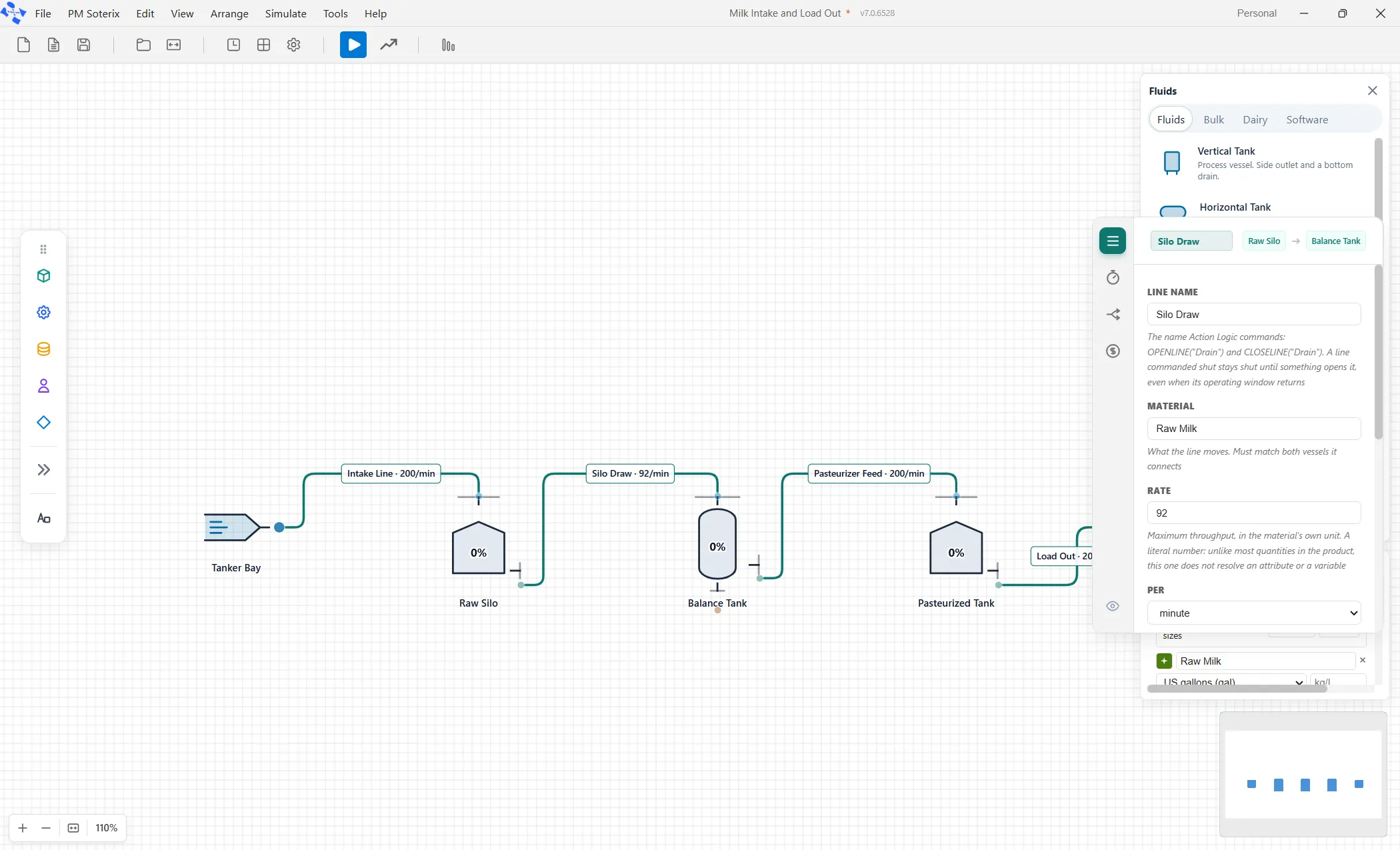
Section titled “The Definitions panel”With the industry palette open, a Definitions panel appears on the right. Its top section is Materials.
Declaring a material
Section titled “Declaring a material”Click New beside Materials. Type the name, such as Raw Milk. Choose the unit from the dropdown, such as US gallons (gal).
That is all a simple model needs. The other boxes, density, value and cost per gallon, and specific heat, are for models that weigh their material, price it, or heat it. Leave them empty otherwise.
One unit, everywhere
Section titled “One unit, everywhere”An operation that mixes dimensions is refused rather than guessed. Liters cannot flow into a vessel measured in kilograms without a density to bridge them, so the product stops and asks instead of inventing a conversion.
A ready-made set
Section titled “A ready-made set”The Dairy face also offers Add materials and sizes, with Imperial and Metric buttons. Either one drops in a ready-made set of dairy fluids and retail pack sizes in one consistent system. It is a shortcut worth knowing; a model that needs only one material just types it.