

Gate Conditions
A gate’s Conditions tab opens and closes it from what is happening in the model, rather than from a clock. Two expressions, each evaluated as the run proceeds.
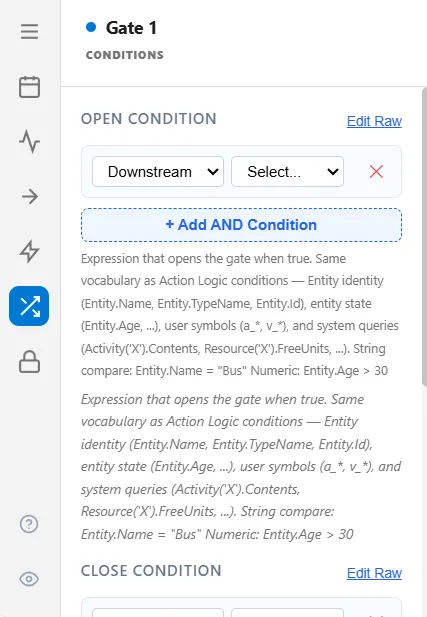
Open Condition and Close Condition
Section titled “Open Condition and Close Condition”- Open Condition: the gate opens when this becomes true.
- Close Condition: the gate closes when this becomes true.
You can set either or both. Build them with the picker, or select Edit Raw to type an expression directly.
What you can put in a condition
Section titled “What you can put in a condition”The same vocabulary as an action logic condition:
| Kind | Examples |
|---|---|
| Entity identity | Entity.Name, Entity.TypeName, Entity.Id |
| Entity state | Entity.Age |
| Your own symbols | attributes such as a_Priority, variables such as v_Ready |
| Model queries | Activity("Pack").Contents, Resource("Loader").FreeUnits |
Compare text with double quotes and numbers bare:
Entity.Name = "Bus"Entity.Age > 30This is also how a gate reacts to a signal: an open condition such as Signal("Go").Active opens the gate the moment that signal is sent.
A gate with no way to open
Section titled “A gate with no way to open”Worth checking before a run: a gate whose Default State is Normally Closed, with no schedule and no open condition, never opens. Nothing is scheduled to change its state, and entities pile up in its waiting queue for the whole run. The only escape is an OpenGate or ToggleGate call from logic.
If a run finishes with everything stacked behind one gate, this is the first thing to look at.
Conditions and logic do not mix well
Section titled “Conditions and logic do not mix well”An OpenGate or ToggleGate call anywhere in the model puts that gate under logic control for the rest of the run, and the conditions on this tab stop governing it from that moment. See Gate Events. Choose one approach per gate.
When the tab is not available
Section titled “When the tab is not available”A gate running as Pull or as a Kanban control is governed by downstream demand, so it cannot also carry conditions. On those gates the tab is hidden and any stored conditions are cleared. See Gate Blocking and Gate Flow Control.