

Fluid and bulk modeling
ProcessModel has two halves. One counts things: patients, orders, parts, people. The other measures them: gallons, liters, kilograms, pounds. The fluid and bulk elements are the measuring half, for a plant where nobody counts the gallons in a silo, they read a level.
Measured, not counted
Section titled “Measured, not counted”A discrete model moves things you can count, and asks how many are here, how long each waited, and how many got through. A plant that handles fluid does not work like that. A vessel holds a level. A pipe moves a quantity per minute, set by the pipe, not by how much is waiting. There is no queue and no waiting line: the questions are how much is in there, how fast it is moving, and what is stopping it from moving faster.
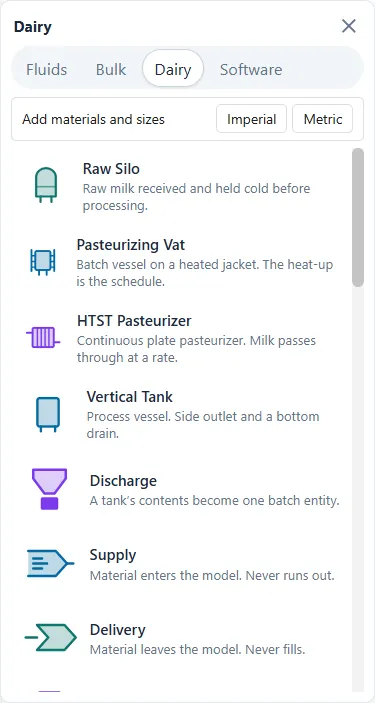
Turn the elements on with View ▸ Show Industry Palettes, then pick a face: Fluids, Bulk or Dairy. Each offers the same vessels, pipes and converters, arriving sized and named for that industry. See Industry palettes and the lens.
The two wire rule
Section titled “The two wire rule”Almost every first fluid model that draws and then moves nothing has an ordinary routing arrow where a pipe should be. It looks finished, it runs, it reports, and it moves no material at all, because no routing arrow has ever moved material and none ever will.
Where the two halves meet there are three converter elements, and only three. A Discharge turns a tank of material into one entity, a Filler turns it into a stream of filled containers, and a Dumper empties an arriving entity back into a tank. Outside those three, the two halves do not touch. See Discharge and Dumper and Filler.
What it does not model
Section titled “What it does not model”The fluid elements are strong on vessels, pumps, flows, fixed-ratio splits and blends with exact mass accounting, filling run lists with changeovers, and washing. They are not a chemistry or thermal simulator, and never claim to be.
No temperature is simulated anywhere. Heating, cooling and holding are expressed as a rate and a time. A vat going from 4 degrees to 63 is an input to a duration calculation, not a jacket that gets there.
No pressure, pH, concentration, viscosity or fat percentage. A separator splitting cream from skim does it by a fixed ratio you supply, not by simulating anything.
Quantities on the fluid elements are plain numbers. A tank capacity, a starting level, a heel, a level mark, a pipe rate: each takes a literal number only, never a variable, an attribute or a distribution. Wash durations, changeover times and breakdown times do accept expressions; the quantities above do not. That rule holds for every fluid element, so it is repeated on each page it touches.