

Import Recipe
Import Recipe turns a recipe you can paste, a formula and its ordered steps, into a working model. Open it from File ▸ Import Recipe, or from the welcome screen.
The two grids
Section titled “The two grids”You paste two things, and each has its own rules.
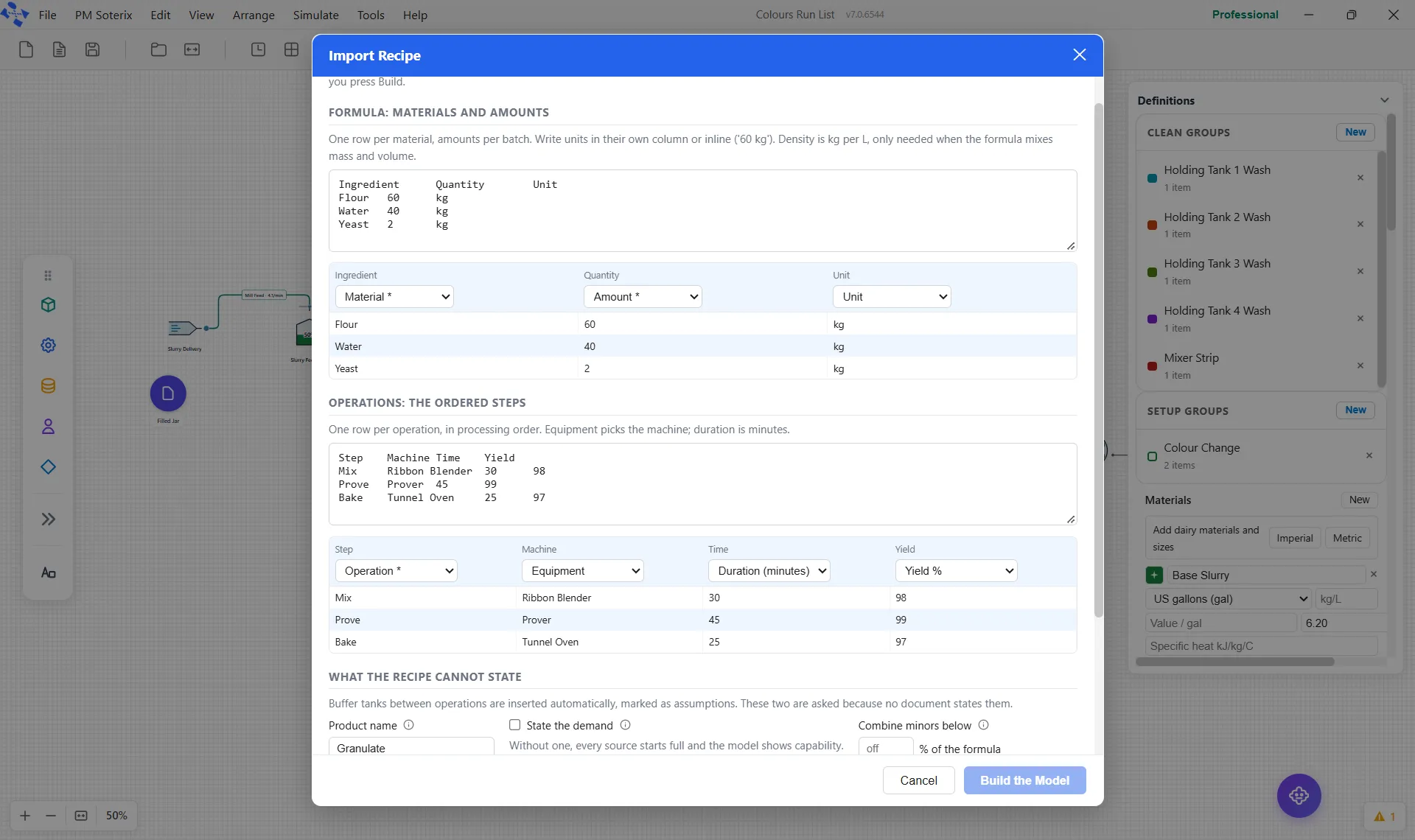
Formula: materials and amounts. One row per material, with amounts per batch. Write units in their own column or inline, such as 60 kg. Density is only needed when the formula mixes mass and volume, because that is the only time a conversion is required.
Operations: the ordered steps. One row per operation, in processing order. Equipment picks the machine, and the duration is in minutes.
Mapping the columns
Section titled “Mapping the columns”Columns are yours to map. The header row is read only to propose a mapping, never to decide it, so a recipe with unusual headings still imports.
The formula maps to Material, Amount and Unit. The operations map to Operation, Equipment, Duration (minutes) and Yield %. The starred targets, Material, Amount and Operation, are the ones it cannot do without.
What the recipe cannot state
Section titled “What the recipe cannot state”A recipe on paper does not say everything a running model needs, so the importer asks rather than assumes. It asks for the product name, whether to state a demand, how many of each machine there are, a threshold for combining minor ingredients, and how the document states its yields, per operation or cumulative down the route.
Buffering is not asked: a buffer tank is inserted between every consecutive pair of operations and marked as an assumption, because a model with no buffers cannot show queueing at all.
What it refuses
Section titled “What it refuses”The refusals happen at the preview, not halfway through a run. Leaving the yield basis or the unit basis unanswered blocks Build the Model, and it explains why rather than picking one:
The preview
Section titled “The preview”Before anything is built, the preview shows exactly what will be created: the counts of unit operations, tanks and materials, and the reminder that nothing lands until you build.
It then separates what you supplied from what it inferred. Pasted values are yours, user-provided and high confidence; everything below that line is an assumption the importer made, visible in the preview and editable on the canvas afterwards. The assumptions are tagged so you can read them at a glance: MATERIALS, SOURCES, DEMAND, BUFFERS, MACHINES and RATES.
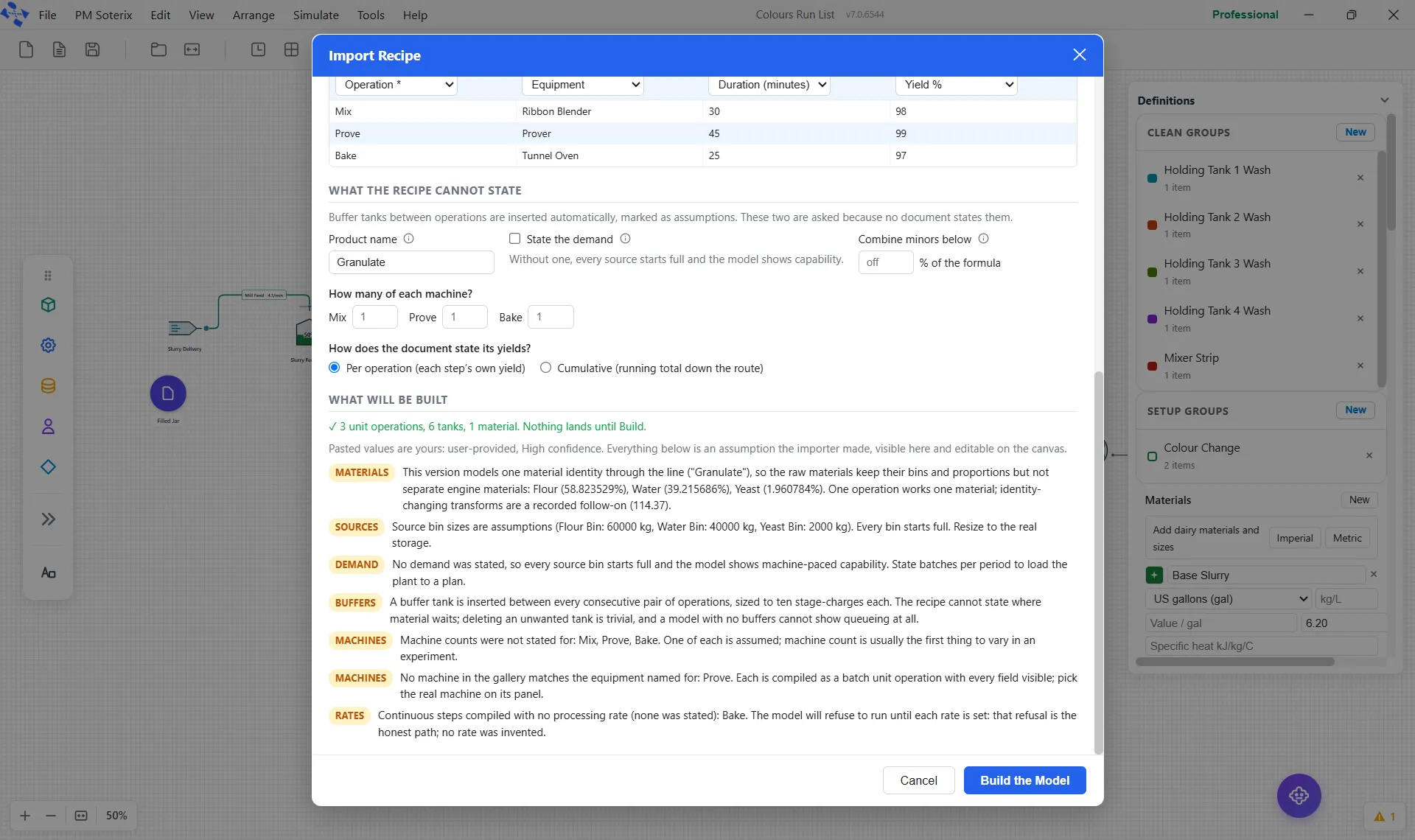
Where a continuous step arrived with no processing rate, the importer refuses to invent one:
Building it
Section titled “Building it”Build the Model hands the compiled changes to the same build pipeline that Build with AI uses, then closes the window. The window itself is deliberate about accidents: Escape closes it, clicking the backdrop does not dismiss it, and Enter never submits.