
Backups
ProcessModel keeps its own copies of the models you work on, on a timer and on demand, so there is something to go back to when a model goes wrong between saves. Open File ▸ Backups to take one, see what has been kept, and bring one back.
Backups are held by ProcessModel itself rather than beside your model file, so they are there even for a model you have never saved. They do not travel with a model you send to someone else.
When a backup is taken
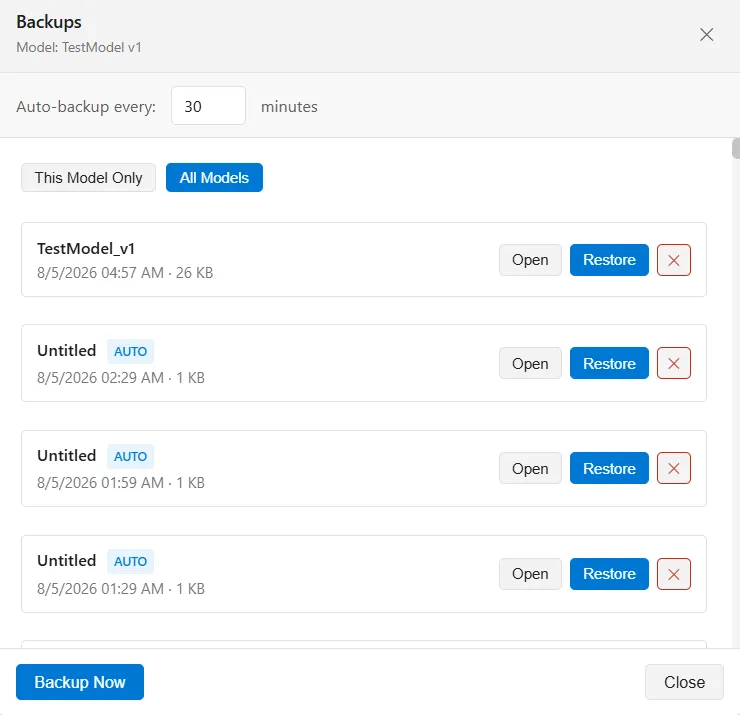
Section titled “When a backup is taken”Backup Now, at the bottom of the window, takes one immediately and adds it to the list under the model’s name.
The rest are automatic. Auto-backup every, at the top of the window, sets how often, anywhere from 1 to 60 minutes, and it starts at 30. It is a program setting rather than a model setting: it applies to every model you work on, and a new interval takes effect the next time you start ProcessModel.
Two things about the automatic ones are worth knowing. Nothing is taken while the canvas is empty, so a fresh session does not fill the list with blank models. And they are skipped when the drive is very low on space, where Backup Now always runs.
Automatic backups carry an AUTO tag in the list. The ones you took yourself do not.
Finding a backup
Section titled “Finding a backup”All Models lists every backup ProcessModel is holding, newest first, whichever model each one came from. This is the view to browse.
This Model Only narrows that to backups taken when the model was exactly as it stands now, so once you have made an edit it is usually empty.
Each row gives you the model’s name, whether it was automatic, when it was taken, and how big it is. Backups are not cleared out on a schedule, so the list grows as you add to it. The ✕ at the end of a row deletes that backup after asking you to confirm, and it is the way to keep the list to a length you can read.
What comes back
Section titled “What comes back”This is the part to be clear about before you rely on a backup.
Restore brings back the diagram as it was: every shape, every connector between them, and the settings held on those shapes and connectors, including names, processing times, capacities, route percentages and action logic. It does not bring back the model’s variables, attributes, arrays, scenarios, process tables, shift schedules, saved distributions or simulation options. Those stay as they are in the model you have open.
Open brings the same diagram back as a separate, unsaved model. Because it arrives on its own rather than into the model you were working on, its variables, attributes, arrays and scenarios come in empty, its simulation options come in at their defaults, and the process tables, shift schedules and saved distributions of the model you had open before carry over to it.
So a backup is a reliable way to recover the layout of a model, and that is what to reach for it for: a shape deleted, a set of connections rerouted, a diagram edited into a shape you did not want. For a complete model, with everything you defined by name as well as everything you drew, the safest recovery is your own saved file. Save early, and treat backups as the safety net between saves rather than in place of them.
Restore and Open, side by side
Section titled “Restore and Open, side by side”| Restore | Open | |
|---|---|---|
| What it does | Replaces the diagram in the model you have open | Loads the backup as a separate model |
| Before it runs | Asks you to confirm | Asks about unsaved changes in the current model first |
| Afterwards | Ctrl+Z undoes it, like any other edit | Arrives named <name> (restored), with no file of its own, so Save asks you where to put it |
Use Restore when the model you have open is the one you want to fix. Use Open when you want to look at an older version beside your current work, or lift something out of it, without touching what you have.
Related
Section titled “Related”- Protect Model for locking a model with a password.
- Demo Models for the ready-to-run examples, which open the same way a backup does.
- Best practices for model building for the habits that keep a model recoverable in the first place.