

Decision Trace
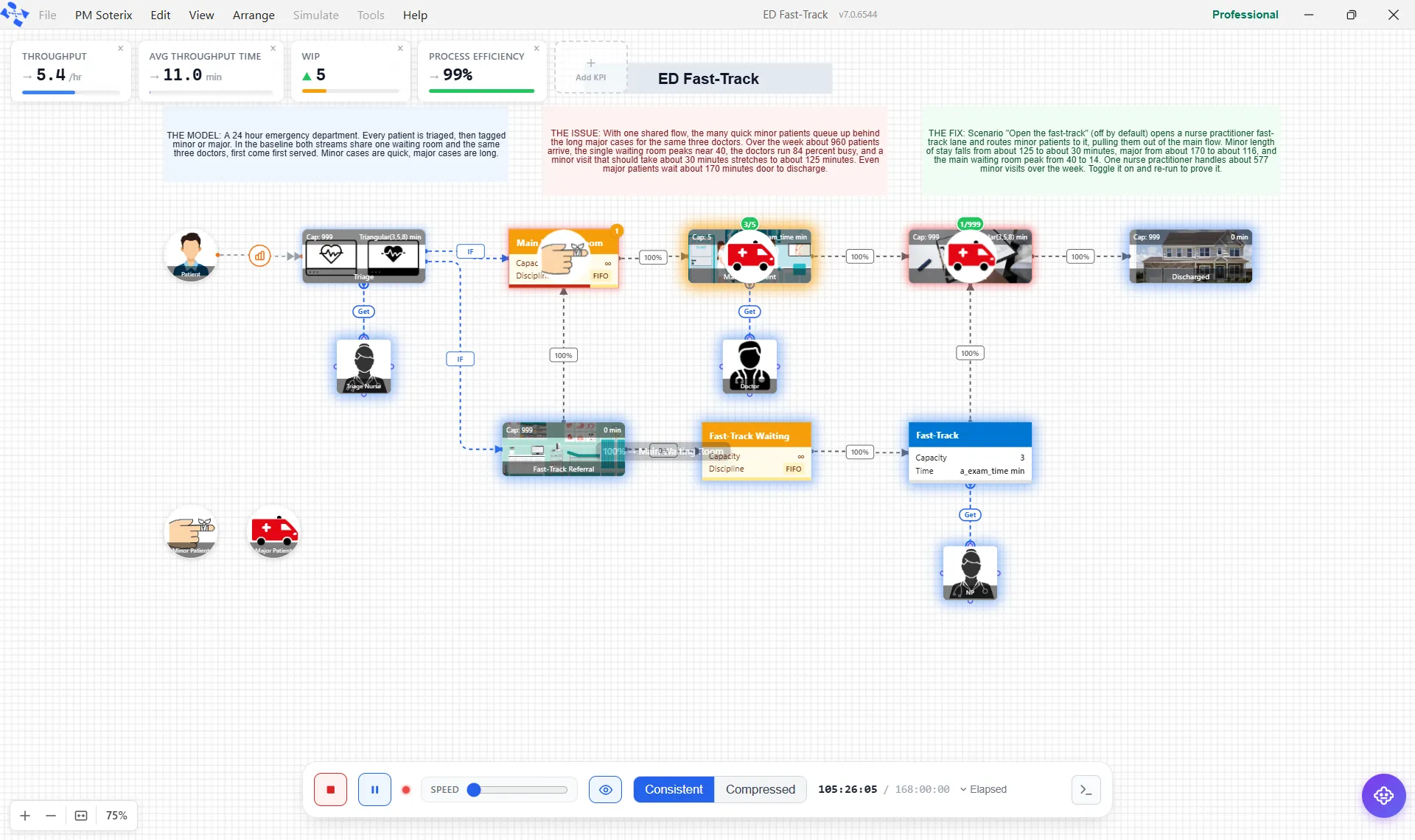
While a run is animating, Decision Trace puts a small chip on the canvas each time a routing decision fires, saying why the entity went the way it did. The chips appear beside the source node’s output side, fade in, hold for about a second and a half, and fade out.
There is nothing to switch on: running the model produces them.
What a label says
Section titled “What a label says”Every chip reads the same way: the reason, then the route it took.
- Percent: the share that sent it, such as 60% and the target it chose. An expression-driven percent shows as a function instead of a number.
- Conditional: the condition that was true, and the target.
- Balancing: which rule picked the target, Shortest Queue, Least WIP, Lowest Utilization or Shortest Cycle.
- Schedule, Available and Alternate: the route taken because of a schedule, because a target was available, or because the alternate was used.
A plain single route, or a default one, produces no chip at all. Only a real decision is annotated, so anything you see on the canvas is a fork the model actually chose between.
Saving and replaying a trace
Section titled “Saving and replaying a trace”Two separate things sit on the File menu, and they can be used together.
File ▸ Save trace as copies the session’s trace file, a .pmdtrace, to a location you pick. It stays greyed out until a run has produced a trace to save.
File ▸ Open Simulation Trace opens a saved animation trace and puts the model into replay mode, so you can watch a run back without running it again.