Simulation Options
Open Simulation Options from the Simulation menu before you run a model. It has three sections: Time and duration, Animation, and a collapsible Advanced section for everything else.
Time and duration
Section titled “Time and duration”- Run length and its unit (minutes, hours, or days): how long the simulation runs.
- Warm-up length: a lead-in period run before statistics start collecting, so a system that takes time to reach a steady state does not skew the results.
- Replications: how many times to repeat the run, each with a different random stream, so you see the range of outcomes rather than a single result. Running more than one replication turns the animation off, since you cannot watch many runs at once.
- Start day: the day of the week the simulation begins. This affects shift schedules and gate time windows.
Animation
Section titled “Animation”- Animation on or off. With it off, the model runs at full speed with no drawing. It turns off automatically when you run more than one replication.
Advanced
Section titled “Advanced”Open the Advanced section for finer control.
Clock display
Section titled “Clock display”- Simulation start date: anchor the clock to a real calendar date. Leave it empty to show elapsed time instead.
- Clock format: show the clock as elapsed time, a calendar date and time (needs a start date), or shift-relative, meaning shift and day (needs a resource with a shift schedule).
Reproducibility
Section titled “Reproducibility”- Base seed: fix the random seed so a run repeats exactly. Generate a fresh one, or lock it to the seed from your last run (shown here) to reproduce that run.
Animation detail
Section titled “Animation detail”- Animation speed: how fast the animation starts. You can also change the speed from the control bar once the run is going.
- Playback mode: Compressed skips over idle gaps so you spend your time where things happen; Consistent paces the whole run evenly.
- Animation segments: limit the animation to certain time windows, for example only the busy hours. Leave it empty to animate the whole run.
- Idle jump notification: in Compressed mode, flag when the animation skips over an idle gap longer than this many hours.
- Capacity badges: show an activity’s contents as a ratio (used out of capacity) or a plain count.
- Show scoreboard: show the live results panel while the model runs.
Statistics and diagnostics
Section titled “Statistics and diagnostics”- Stats update interval: how often the live results refresh, in simulation time. More often gives a smoother dashboard and a larger output.
- Queue bucket collection: collect detailed over-time statistics on queues, activities, and gates, which feed the Queue Diagnostics heatmap. You can override it per item in their own properties.
Restore defaults resets everything, and Apply saves your changes.
LegacyHow this worked in the previous version
Accessed from the Simulation menu, the Options dialog contains the settings and information you will use to run your model. Be sure to review these settings before running the simulation of the model. Once you are familiar with these options and have set them according to your objectives, you can run the simulation.
If the first entity arrives in the model at 8:00am the simulation clock will jump ahead to that event. This happens when there is a daily pattern or scheduled arrival of entities to occur at 8:00am. If no events are occurring in the simulation, the clock jumps ahead to a point when some action is taking place.
Each ProcessModel simulation begins at 12:00 a.m. (midnight) on Monday morning (of the first week).
Run Tab
Section titled “Run Tab”Run length The length of time for running the simulation. You may use any constant or expression to indicate the length of time the simulation will run.
The longest a model can run a simulation for is 71,582 hours or 2,982.6 days or 8.17 years approximately. The smallest time allowed is .06 seconds, .001 minutes, or .000017 hours.
Warmup length The length of time to run the simulation before collecting statistics. Many systems require a time to warm up before they are running at a steady state, and if you collected statistics during this warm-up period, your results would likely be skewed. This option allows you to define that time to allow your model to warm up before you begin collecting statistics. Again, any constant or expression may be used in this field. The scoreboard values will reset after the warmup period ends. This is the designed purpose of the warm up length.
The longest warm-up length allowed is 17,520 hours.
What are replications? A replication is a repeating run of a simulation experiment changing the random number seed. Changing the random seed means the variation changes - as if you could observe different periods of data. Monitoring different data sets or replications allows a more realistic representation of what could happen due to stochastic parameters. Without replications, the simulation won’t produce statistically significant results, nor will it allow for proper calculation of statistical data.
Use replications when running comparisons, testing variation, and performing risk analysis.
Report time units Allows you to select the default time units to use when you run the model.
Show Animation If checked, the process will be animated during the simulation. Disabling the animation enables the simulation to run faster and consumes less memory.
Show Scoreboard Check to display basic performance measures (entities processed, value-added time, etc.) during the simulation.
Scoreboard Time units Allows you to select the time unit displayed in the scoreboard at the time of simulation.
Disable sub processes Causes the simulation to be run the main model only (no submodels are executed). Individual submodels can be disabled in the Activity dialog.
The ProcessModel simulation clock runs straight time using 24 hour days, 7 days per week. If there is a need to avoid the shift files to compensate for evenings and weekends, just run straight work time (not being concerned with the “day of week”), it can reduce the simulation run length to 40 hours per week. For example, a normal 7 day work week is 168 hours (7 x 24). To run a model without shift files for 4 weeks, using a 5 day workweek at 40 hours per week, reduce the run length from 672 hours (4 x 168) to 160 hours (4 x 40). Caution: Daily Pattern or Scheduled arrivals can not be used with this technique because the clock is no longer tracking 24 hour days. Continuous, Periodic, or Ordered arrivals will need to be used.
Files Tab
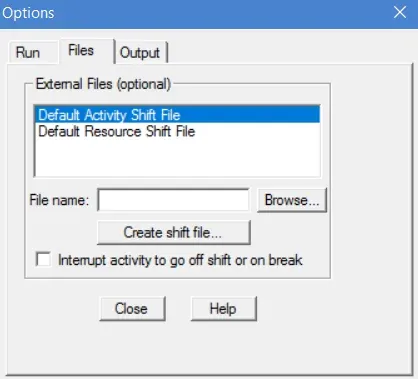
Section titled “Files Tab”External Files This option allows you to include shift files for activities and resources.
Create shift file Allows you to create a shift file for the model.
Interrupt activity to go off shift or on break When you check this option, ProcessModel will interrupt an activity or resource (whether or not it is currently busy) to cause it to go off shift or on break. Use this only for activities or resources you can interrupt.
Graphics Tab
Section titled “Graphics Tab”ProcessModel version 5.6.2 and above do not support this feature. The Graphics tab allowed you to use a custom graphics library in the model and was provided primarily for compatibility with earlier versions of ProcessModel. If you have models built in version 2.1 or earlier and you don’t want to add any custom entity icons to the models, uncheck the “Use custom graphics library for simulation” box. This will conserve the disk space required to generate a custom graphics library.
Output Tab
Section titled “Output Tab”Show standard deviation When you check this option, ProcessModel will show standard deviation in the cycle time calculation of the Output Summary.
Number of cycle time Allows you to choose the size of the cycle in which the standard deviation is sampled. Larger samples use more processing memory.
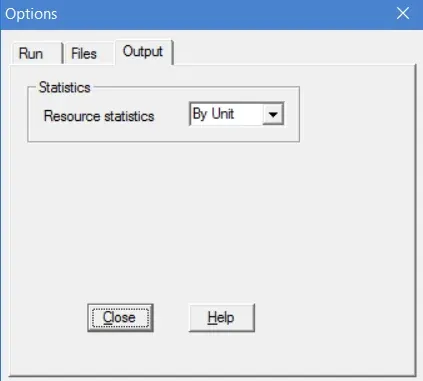
Statistics Allows you to choose if resource stats will be shown by unit or in a summary of all units.