

Alternate Connector
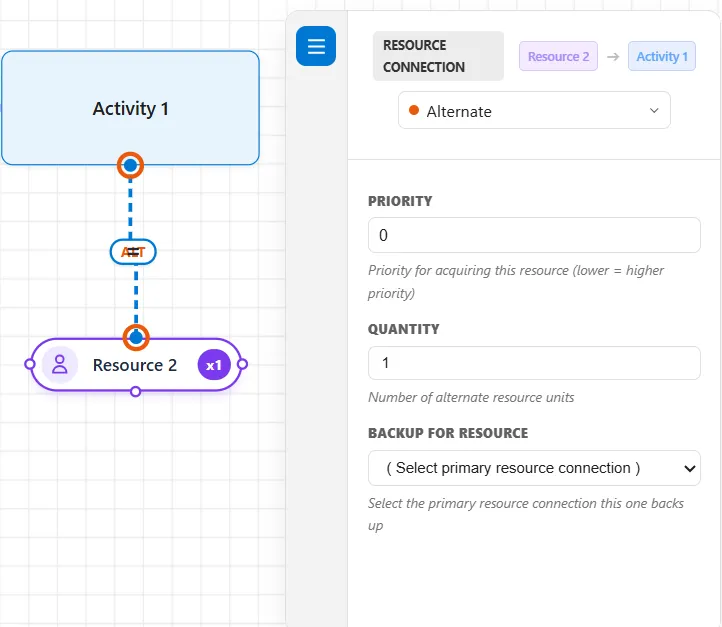
An Alternate connection gives an activity a backup resource, used only when the primary resource is busy. Draw it from the backup resource to the same activity as the primary, then choose which primary it backs up.
Use it for overflow capacity, like a senior operator who steps in only when the regular operators are all occupied.
Settings
Section titled “Settings”- Backup for: the primary resource connection this one backs up. The primary is always tried first; the backup is reached only when the primary is unavailable.
- Quantity: how many units of the backup to seize.
- Priority: the order this activity acquires the resource when there is competition.
When the resource belongs to a resource group, alternates are defined in the group instead.
LegacyHow this worked in the previous version
To use a resource as an alternate to another resource, connect the alternate resource to the other resource’s assignment connection as shown in the illustration below. If the resource units of the connection to which it is attached are unavailable, the alternate resource will be used. If neither one is available, the first available resource will be used.
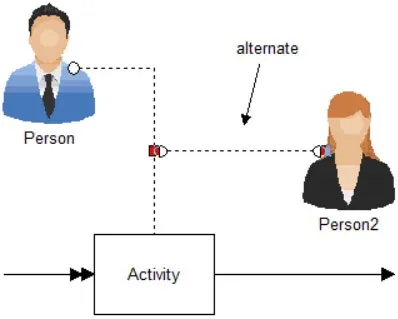
You can use the quantity field on the alternate route to define how many resources you need to work on an entity if the primary resource is unavailable.
Alternate to an Alternate
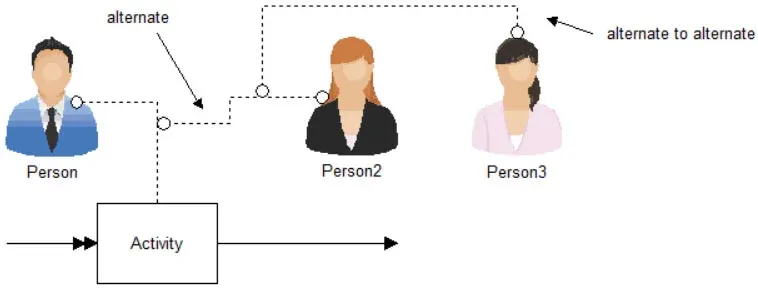
Section titled “Alternate to an Alternate”To define an alternate resource for an alternate resource, simply connect the resource to the other alternate connection as shown below. No more than one alternate may be connected to another resource connection so that the order of preference in selecting resources is clear. To define multiple alternate resources, simply continue connecting an alternate resource to each previously connected alternate resource.
Alternate to a Get Connection
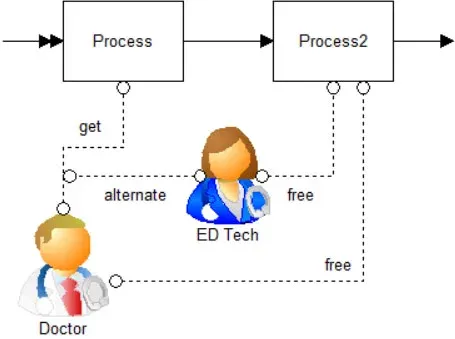
Section titled “Alternate to a Get Connection”When an alternate resource is connected to a Get resource connection as shown in the following illustration, the resulting captured resource must be freed with either a Free resource connection or a FREE statement in Action logic.
Since you cannot know which resource will be captured when assigning resources as alternates to a Get resource connection, you must create a Free resource connection for every possible resource as shown above. Doing this will free the resource that was captured and ProcessModel will ignore the other Free resource connections. See “FREE” for the use of FREE ALL in action logic.
Alternate Resources On Different Shifts
Section titled “Alternate Resources On Different Shifts”Define an alternate resource on a different shift in the same manner as the alternate descriptions provided above. Assign each resource type to the appropriate shift. See “Defining & Editing Shift & Break Blocks” . If a resource is off shift, a check will be made to see if the alternate is available.
Types of Connectors
Section titled “Types of Connectors”Using alternate resources on an activity
Section titled “Using alternate resources on an activity”Designating a resource to use as an alternate if the primary resource assigned to the activity or move is unavailable.
Suggested Technique
Section titled “Suggested Technique”- Connect the primary resource to the activity or routing.
- Connect the alternate resource to the primary resource connection.
Alternative resources may also be captured using the GET or JOINTLYGET statement with the OR operator. Connected resources will always be captured before resources specified in a GET statement. On the other hand, resource connections that free a resource occur after any Action logic for the activity.
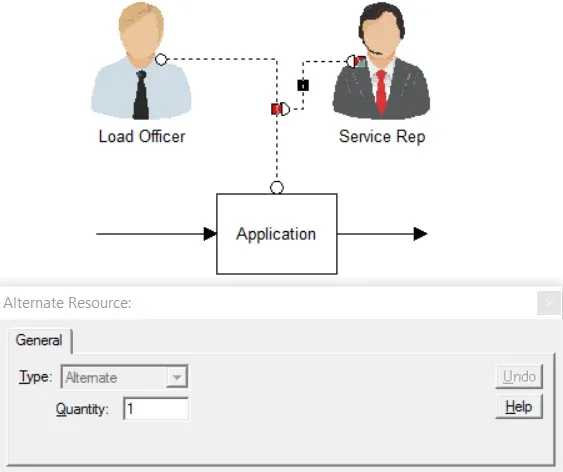
Example: Normally the loan officer will help the customer with the loan application at the Application activity, but if no loan officers are available, a customer service representative can take the loan application.
TO DO: Connect the Service Rep (the alternate resource) to the assignment connection between the Loan Officer and the Application activity as shown above.
- To learn more, see Resources and Resource Assignments.
- If you use a GET connection (instead of a GET & FREE) to capture a resource and then connect an alternate resource to that connection, you must connect a free connection to both the primary and alternate resources when the resource is freed. One free connection is then executed and the others are ignored; the correct resource is freed without you knowing which one was captured.