

Industry palettes and the lens
ProcessModel is one general tool that models a hospital, a milk plant, a warehouse or a software team from the same handful of elements. The industry palettes add a second, optional panel, docked on the right, that curates those elements for one industry. There are four faces: Fluids, Bulk, Dairy and Software. Three of them are element-curation faces. The fourth, Software, is a lens, which is something more.
Turning the palettes on
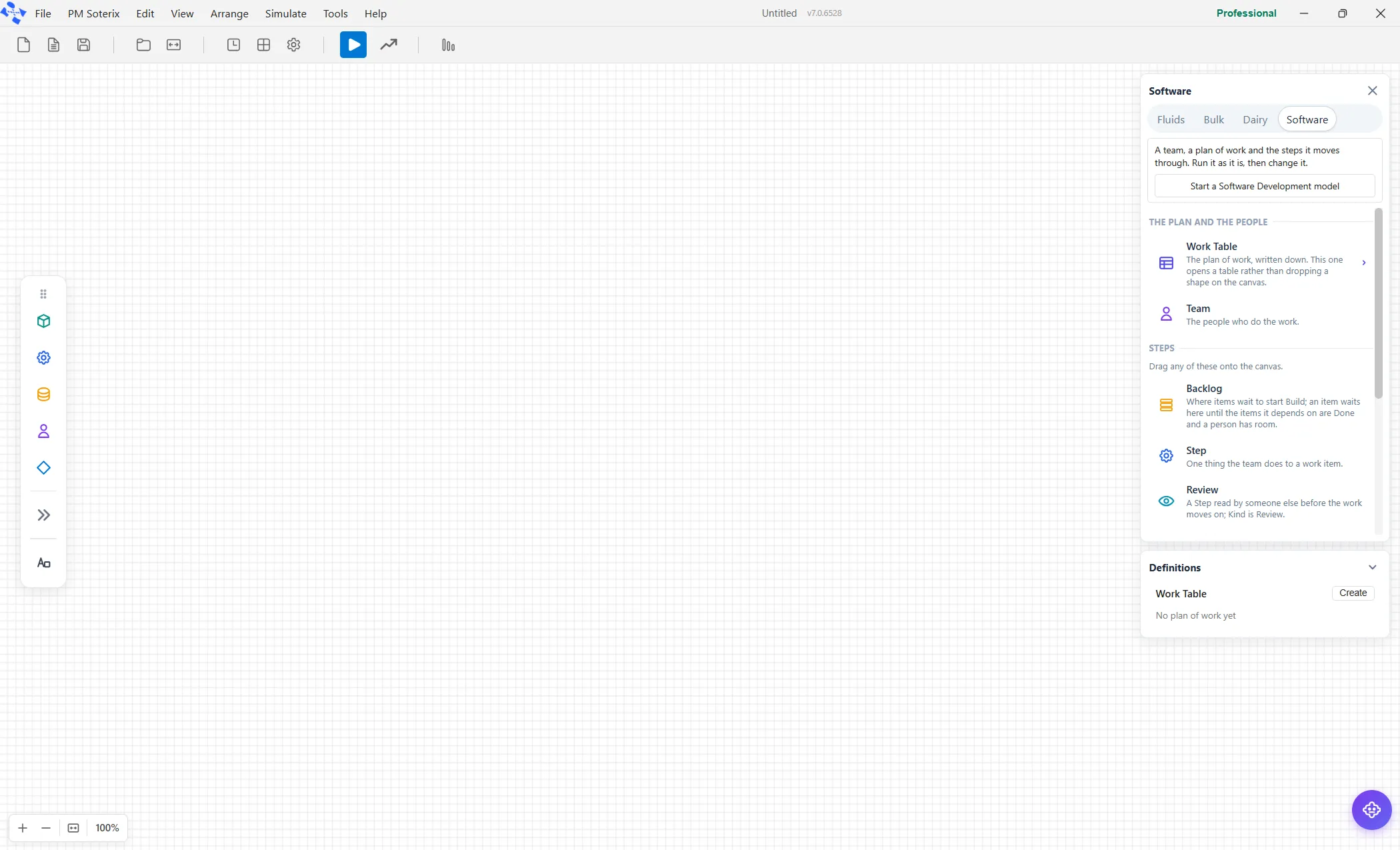
Section titled “Turning the palettes on”Open the View menu and click Show Industry Palettes. A panel docks on the right, with a row of tabs across the top, one per face.
View ▸ Show Industry Palettes is a toggle, and it remembers. Click the menu item again to close the panel, and it returns where you left it next time.
On an empty canvas the panel shows its faces but no lens row at the foot, because there is nothing yet to put a lens on. That row appears once the canvas has elements.
The four faces
Section titled “The four faces”The tabs across the top of the panel are the four faces: Fluids, Bulk, Dairy and Software.

Fluids, Bulk and Dairy are element-curation faces. Each one offers the elements a given industry needs, arriving already sized and named for the job, and it changes nothing else. The words on your fields, the tabs in the report, and the run settings all stay exactly as they are in general ProcessModel.
The Software lens
Section titled “The Software lens”The Software face does everything the curation faces do, and then puts the whole model into a delivery team’s language. Turning it on changes what you read in four places. It changes nothing about what is computed.
The ten tiles
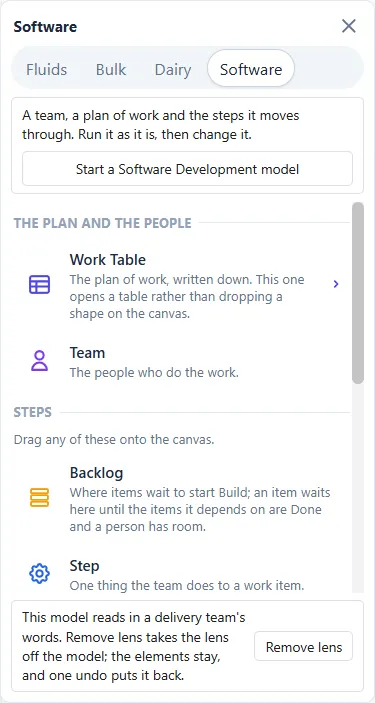
Section titled “The ten tiles”Under the Software heading are ten tiles, each with its name and a sentence: Work Table, Team, Backlog, Step, Review, Test, Pipeline, Release, Freeze and Done. Nine of them drop an element on the canvas; Work Table opens the plan of work instead.
The words on the fields
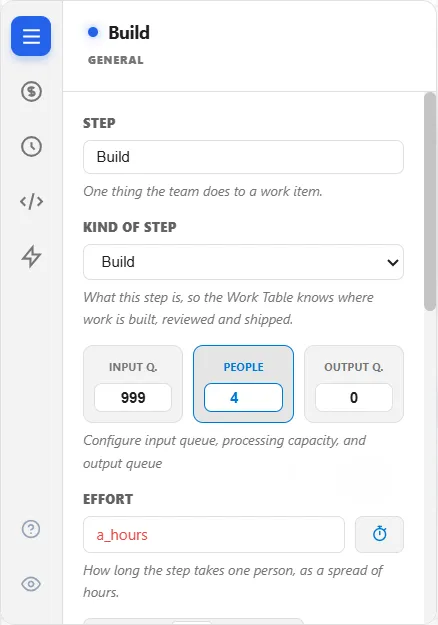
Section titled “The words on the fields”With the lens on, the fields you edit carry the team’s words. Each one is the same setting as before, computed the same way, wearing a different label.
| General ProcessModel | With the Software lens |
|---|---|
| Entity | Work item |
| Activity name | Step |
| Processing Time | Effort |
| Queue | Backlog |
| Resource | Team |
| Quantity | People |
| Capacity | People (per step) |
| Overtime multiplier | Overtime rate |
| Shift schedule | Working hours |
| Renege after | Dropped from scope |
The report and the run settings
Section titled “The report and the run settings”With the lens on, the Output Report hides its general tabs and shows five in the team’s language: Forecast, Flow, Team, Quality and Cost. In the run settings, Replications is called Runs.
The lens row
Section titled “The lens row”At the foot of the Software face is a single row about the lens itself. What it offers depends on the model that is open.
A model that has elements but no lens offers Use the lens.
A model that already wears the lens offers Remove lens.
An empty canvas shows no row at all, because there is nothing to put a lens on.
Either button changes the model, and one press of Ctrl+Z puts it back. Nothing is lost either way, because the lens only decides what you read.
Where the lens lives
Section titled “Where the lens lives”The lens is stored inside the model file, so a model either wears it or it does not, and two models open side by side can differ. A model that wears the lens still opens in a copy of ProcessModel that never heard of it: the words fall back to the general ones, and the model runs exactly the same.
That is what a lens is. It is a pure view of what you read, never a change to what is computed. Take the lens off, and the same model gives the same answer, to the last decimal place.