

Sequence Planner
The Sequence Planner compares candidate run orders for one filler and prices each against the changeover matrices, so you can see what an order costs in changeover minutes before you commit to it.
Opening it
Section titled “Opening it”Open Simulate ▸ Sequence Planner. It needs a filler that already has rows in its run list. With none, it says so instead of guessing:
No shipped demo arrives with a filler run list already populated, so to see the planner scored you first add rows to a filler’s Run List, then open the planner.
Three candidates
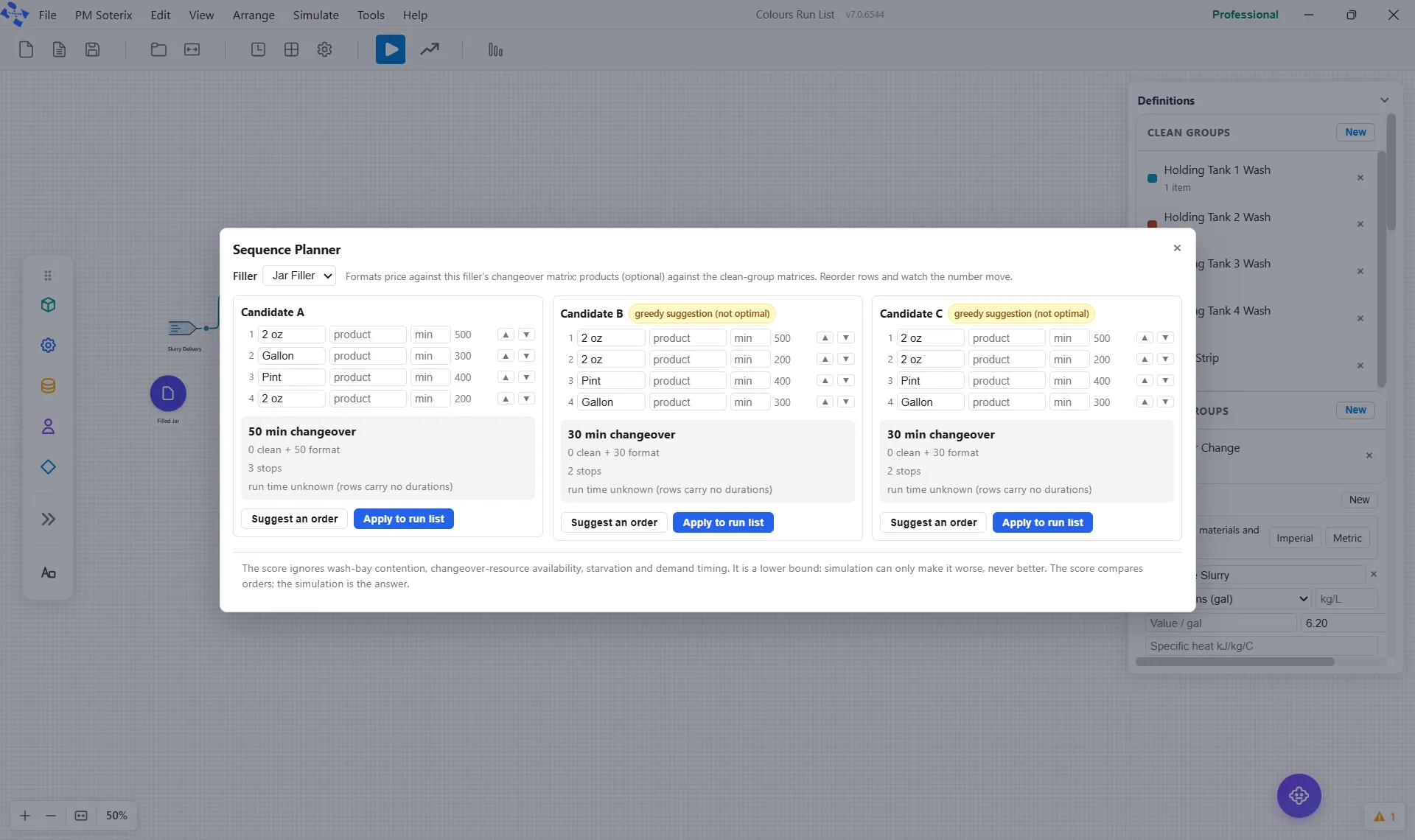
Section titled “Three candidates”A Filler picker sits at the top and decides which changeover matrices the score is priced against. Below it are three candidate columns, Candidate A, Candidate B and Candidate C. Candidate A seeds from the chosen filler’s current run list, and B and C start as copies of it, so you always have the order you have now plus two to play with.
Each row carries a format, an optional product, an optional minimum, and a quantity. Rows are editable, and the up and down buttons reorder them. Change an order and the score moves with it.
What the score says
Section titled “What the score says”Each candidate is scored instantly by walking the two changeover matrices. The block under a candidate reports:
- the total changeover minutes for that order,
- the split behind it, so many minutes of clean plus so many of format,
- the number of stops, noting where stops were coalesced,
- the running minutes and the percentage that is changeover, or run time unknown (rows carry no durations) when the rows carry no times to run.
A figure that came from a distribution is scored at its mean and tagged est. Where a transition has no price in the matrices, the planner says so plainly, as so many transitions not priceable, scored at zero, rather than inventing a number.
Suggesting and applying an order
Section titled “Suggesting and applying an order”Suggest an order reorders a candidate with a greedy pass. The result is honest about what it is: it carries the badge greedy suggestion (not optimal).
Apply to run list writes the filler’s run list in the candidate’s order, with the quantities intact. One order is refused:
A candidate with a REMAINDER row anywhere but last will not apply, because a row that runs until the tank empties cannot be followed by anything.
What the score does not include
Section titled “What the score does not include”The planner is deliberate about the edge of what it knows, and says so along its foot.

Use it to rank orders quickly, then run the model to find out what the day really costs.